
How Labrador Colors Can Stay Hidden for Generations
In recent years, dilute-colored Labradors, often called silver, charcoal, or champagne, have become more widely recognized and sought after. Yet for most of Labrador Retriever history, the official colors acknowledged by registries like the AKC have been black, yellow, and chocolate. So how have dilute colors remained hidden for so many generations? The answer lies in genetics.
The Science Behind Labrador Coat Color
Coat color in Labradors is controlled by several genes, but two of the most important are:
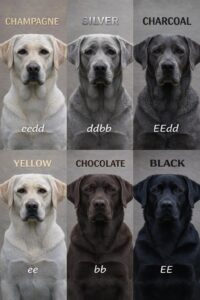
The B gene – determines whether the dog is black (B) or chocolate (b).
The E gene – controls whether pigment is expressed (E) or masked to yellow (e).
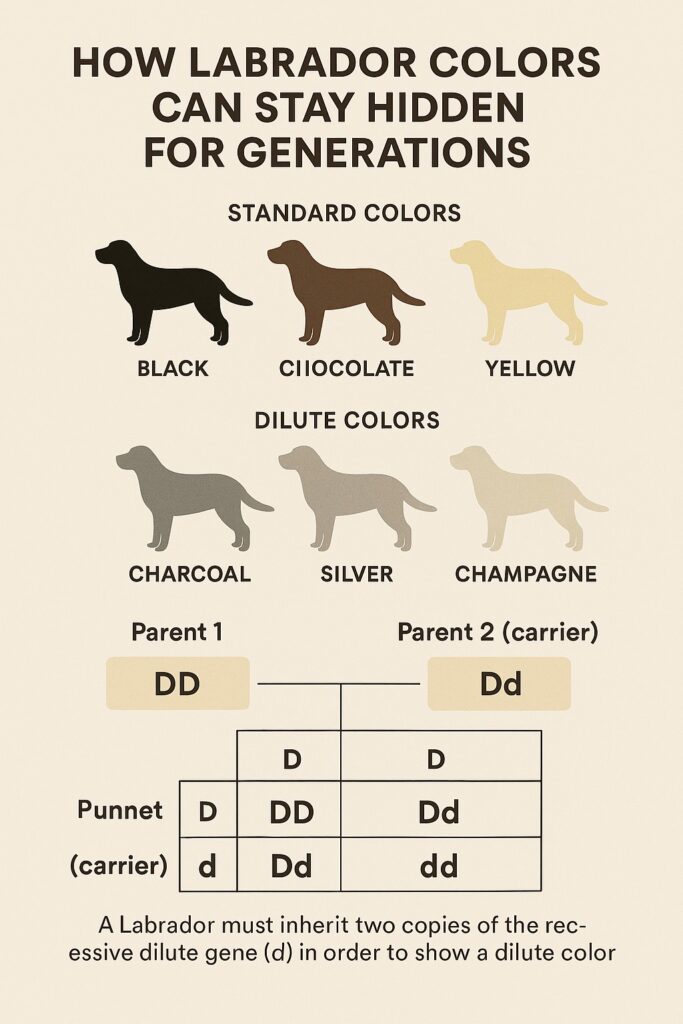
The D gene (Dilute gene) – modifies how dark or light the pigment appears.
• The dominant form (D) produces standard, full pigmentation (black, chocolate, yellow).
• The recessive form (d), when present in two copies (dd), dilutes the base color.
Correct Dilute Expressions:
• Black (BB) + dd → Charcoal
• Chocolate (bb) + dd → Silver
• Yellow (ee) + dd → Champagne
For the dilute gene to show, a puppy must inherit two copies (dd) — one from each parent.
Why Dilute Colors Stay Hidden
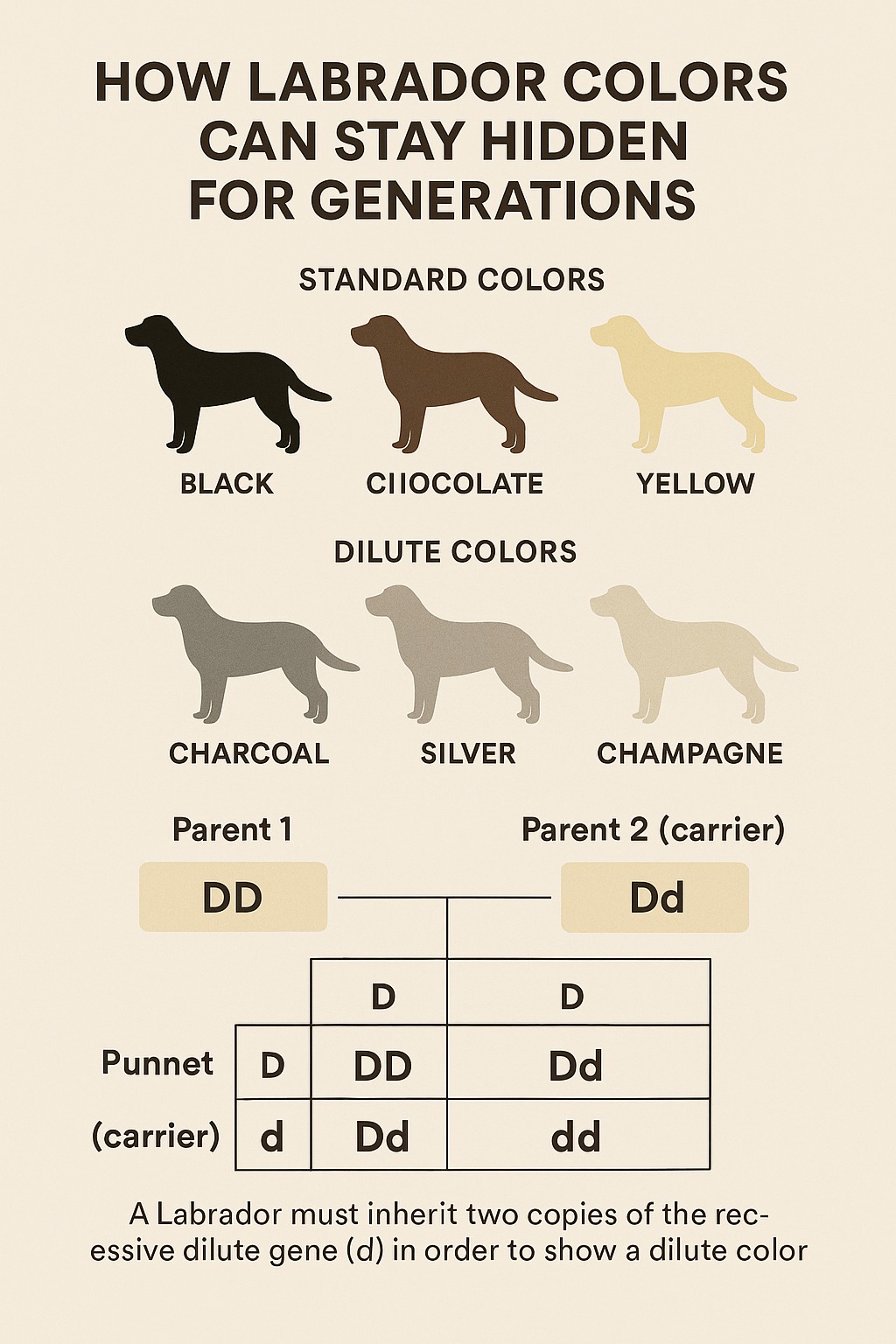
If a Labrador has only one copy of the dilute gene (Dd), it looks like a normal black, yellow, or chocolate Lab. The “little d” gene remains silent, passed down unseen through generations. Only when two carriers (Dd × Dd) are bred together does the chance arise for dilute puppies.
• Dd × DD = No dilute puppies (all look standard, though some may be carriers)
• Dd × Dd = 25% dilute (dd), 50% carriers (Dd), 25% standard non-carriers (DD)
Because D (full pigment) is dominant, most litters over many decades never showed dilute coats, even though carriers were quietly present. This explains how dilutes could exist genetically but not appear visibly until recent generations when carriers happened to be bred together more often.
Probability in Litters
Like tossing a coin, genetics involve probability, not guarantees. Even when two carriers (Dd) are bred:
• A litter could have no dilute puppies (if all inherit the dominant D).
• Or it could produce multiple dilutes.
Over many generations, this statistical chance allowed the dilute gene to persist quietly in the breed.
The Challenge with Yellow Labradors
Because yellow Labradors (ee) already mask pigment, it is often impossible to visually know whether they carry the dilute gene. DNA testing is the only reliable way to determine if a yellow Lab is Dd or DD. This means dilute genes can pass unnoticed in yellow lines for generations.
In Summary
The dominance of the standard Labrador colors (black, yellow, chocolate) has kept dilute genes hidden in the background for decades. Carriers can look completely standard, passing the dilute gene silently until two carriers meet and produce dilute puppies. Scientifically, this explains how dilutes are not a sudden “new” development, but a genetic trait that has always been part of the Labrador population.