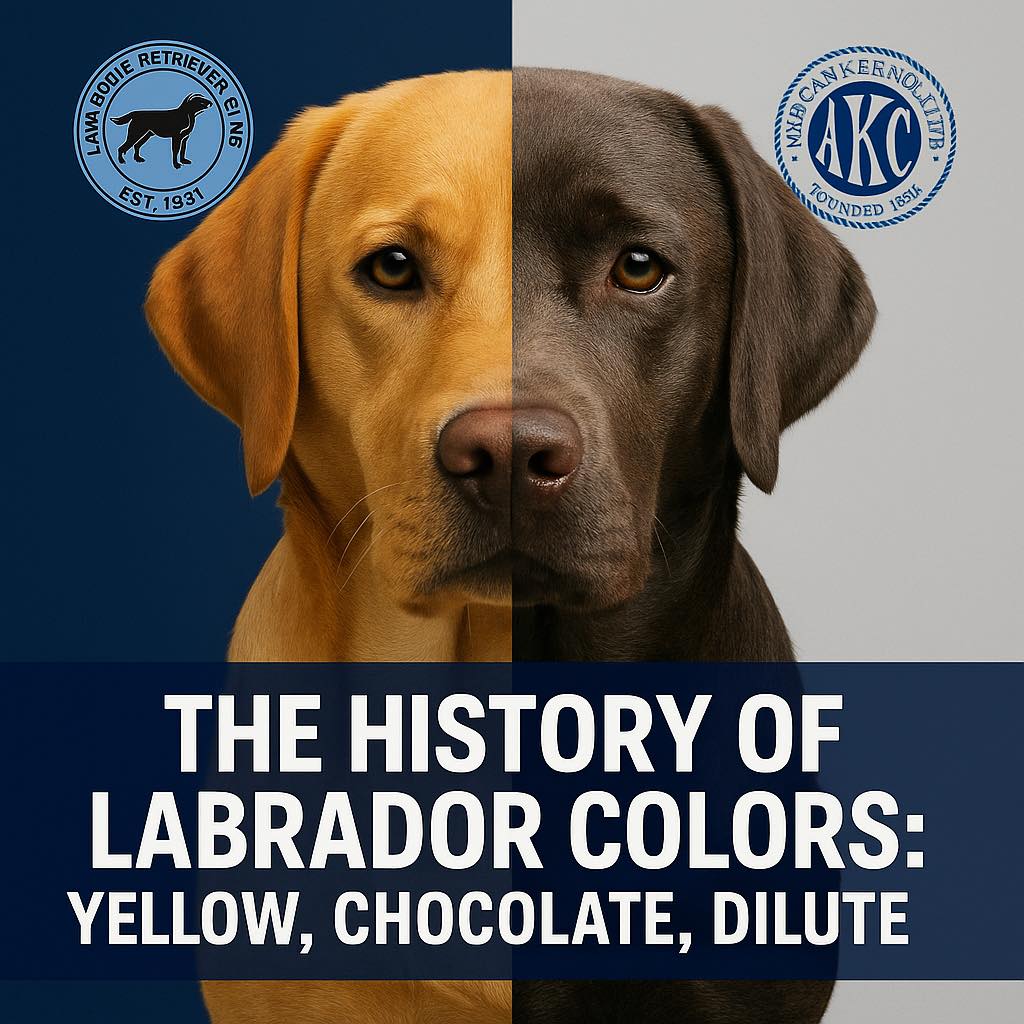

There is a lot of debate surrounding dilute Labradors, but one point often gets overlooked. The origin story has been argued for decades, yet it no longer changes the genetic reality in front of us. Once a color has existed inside a closed gene pool for more than 40 years, the variant becomes part of the breed’s genetic landscape. That is how population genetics works, regardless of anyone’s personal preference.
History Repeats Itself, But With a New Twist
The Labrador breed has already walked this path before with yellow and chocolate. Both colors faced heavy resistance early in their history. But there is one major difference between then and now:
yellow and chocolate did not have to contend with the modern online propaganda machine.
In the early days, opinions spread slowly. There were no Facebook groups, no viral posts, no echo chambers, and no coordinated campaigns. Arguments burned out naturally because breeders eventually interacted with the dogs themselves, saw their quality, and allowed experience to reshape their views.
Today’s environment is very different. Information travels instantly, opinions can spread before facts are checked, and small groups can amplify negativity far beyond their actual influence. This environment makes normal breed evolution look far more dramatic than it really is.
A Quick Look Back: Yellow and Chocolate Resistance
1. Yellow Labradors
In the late 1800s and early 1900s, yellows were treated as undesirable. They were quietly placed, rarely bred, and seen as a flawed expression of the “true” Labrador.
2. Chocolate Labradors
Chocolates faced the same hostility well into the mid-1900s. They were criticized for temperament, health, and type. Once breeders invested in the color and produced high-quality dogs, the stigma faded.
Without social media magnifying every opinion, these controversies solved themselves the way breed development normally does: through time, data, and real-world results.
What We Know Today About Dilute Labradors
Setting emotion aside, the genetic facts are consistent and measurable:
• Dilute Labradors have been in AKC pedigrees for over 40 years, which equals multiple dog generations.
• DNA profiles and haplotypes place dilutes firmly within the Labrador gene pool.
• Once a variant stabilizes in a closed registry for decades, it becomes part of the breed genetically, even if culturally controversial.
At that point, the conversation naturally shifts from Where did the color come from?
to
How do we steward and improve it now that it is established in the breed?
The Purebred Color Cycle
Across dog breeds, color controversies almost always follow the same pattern:
1. A rare or uncommon color appears or becomes noticeable.
2. Preservationists push back hard.
3. Myths and assumptions fill the vacuum where data is lacking.
4. As more generations pass, quality dogs are produced.
5. The color normalizes and becomes part of the breed’s accepted range.
The only difference today is that social media amplifies the resistance phase. Every controversy feels bigger because platforms reward emotional content and conflict. But the underlying genetics and historical patterns have not changed. They are the same now as they were when yellow and chocolate were considered “wrong.”
Final Thought
We do not all have to like every color. Preference is personal. But genetics, history, and 40 years of pedigree reality tell us something important. A color that persists across multiple generations in a closed gene pool does not disappear because people dislike it. It integrates into the breed. And the responsibility then falls on ethical breeders to manage it well.
The truth is the breed evolves. The conversation evolves. Social media just makes the noise louder, not the facts stronger.