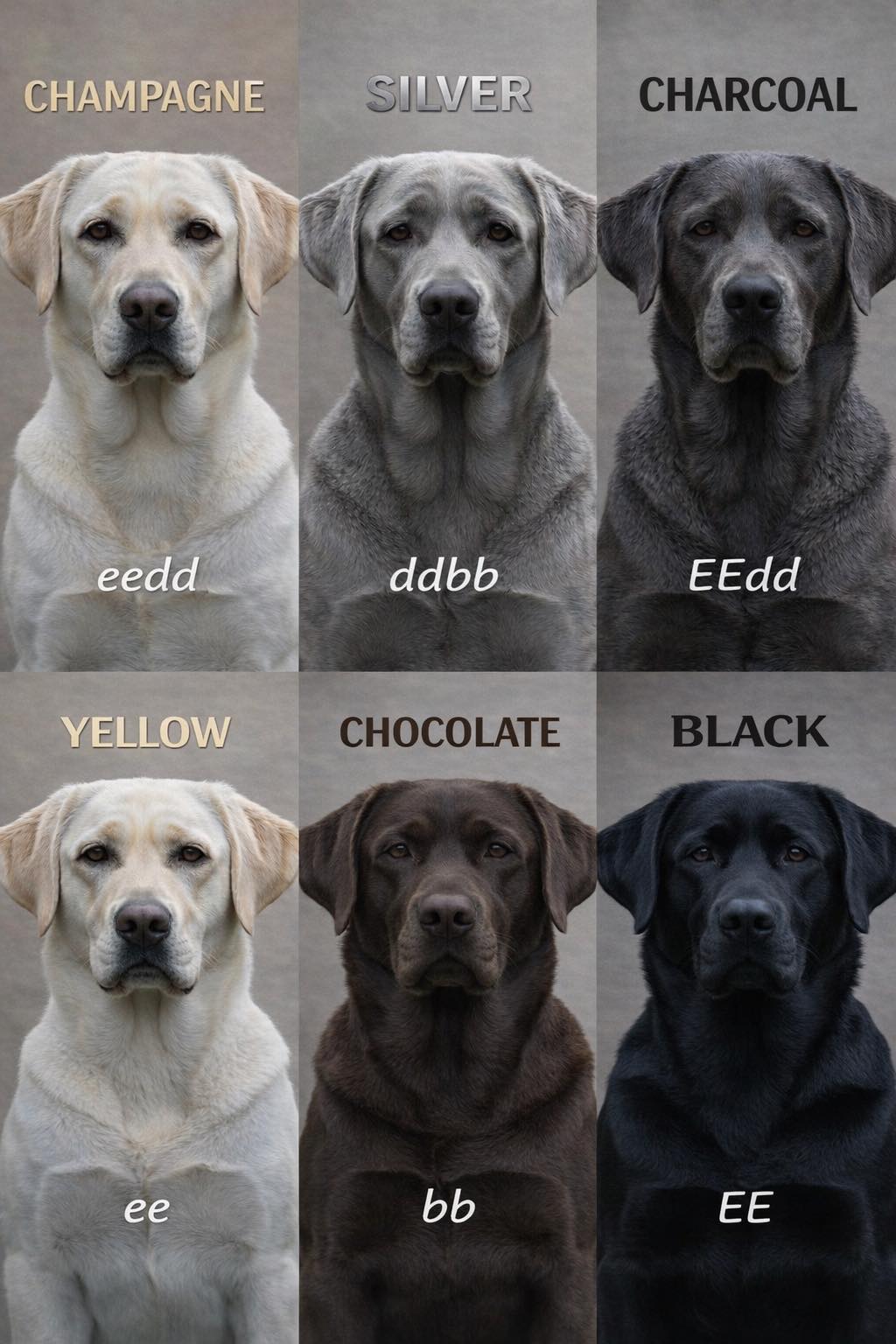

Coat color genetics in Labradors are straightforward once emotion is removed from the discussion. The confusion surrounding dilution does not come from complexity in the genetics but from misunderstanding how recessive inheritance behaves in a large, interbreeding population.
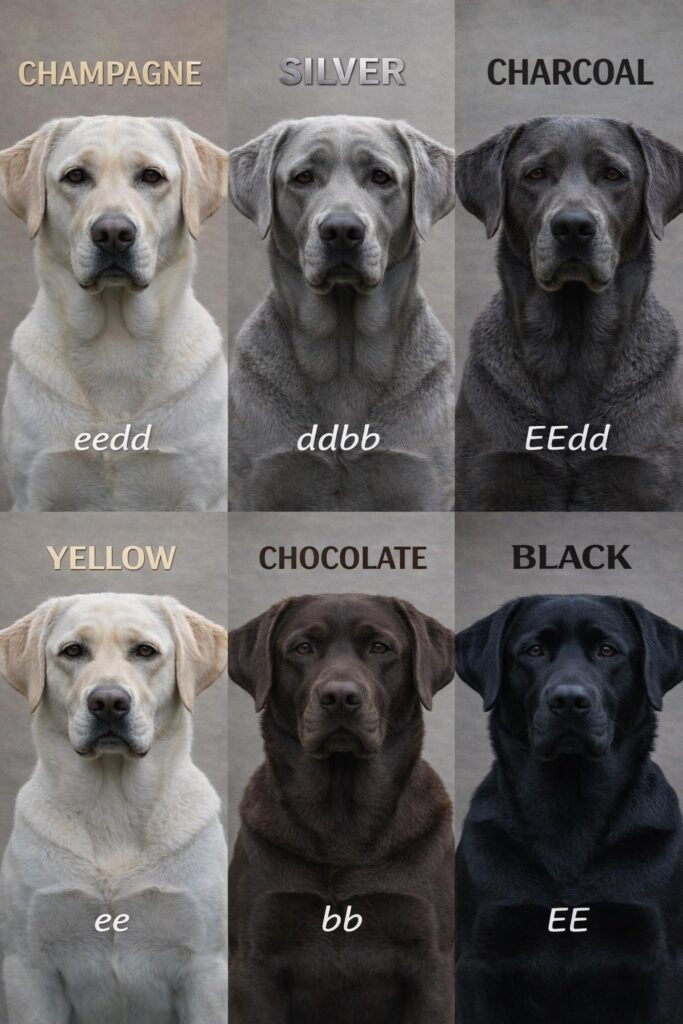
The dilute gene operates as a simple autosomal recessive. A Labrador must inherit two copies of the dilute allele dd to visibly express dilution. This is what produces silver from black, charcoal from black with yellow factors, and champagne from yellow or chocolate backgrounds.
A dog with only one copy Dd is a carrier. Carriers are phenotypically indistinguishable from non carriers. They look like ordinary black, yellow, or chocolate Labradors and provide no visual signal that dilution is present in their genotype.
This invisibility is the key reason dilution can persist quietly for long periods of time.
The effect is amplified when yellow Labradors are involved. Yellow expression is controlled by the ee genotype at the E locus, which suppresses the production of dark eumelanin pigment in the coat. When a yellow Labrador also carries one copy of dilute Dd, there is no visible change at all. The dog appears as a standard yellow Labrador, with no outward indication that dilution is present in the background.
As a result, yellow Labradors can carry the dilute gene silently across multiple generations. If those carriers are bred to non carriers, dilution remains hidden. If carriers are bred to other carriers, the gene continues to circulate unnoticed. Nothing appears unusual until two carriers are bred together and the statistical outcome finally produces a dd offspring.
When that happens, people often assume something new has been introduced. Genetically, nothing new occurred. The inheritance pattern simply aligned.
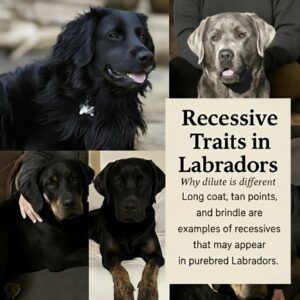
This is not unique to dilution. It is how all recessive traits behave. Recessive alleles do not require constant selection pressure to persist in a population. They only require carriers to reproduce. As long as the allele remains invisible, there is no natural or artificial pressure eliminating it from the gene pool.
In a large population like the Labrador Retriever, with millions of registered dogs and extensive interbreeding over generations, recessive alleles can persist for decades or longer without drawing attention. Their eventual expression does not indicate recent introduction. It indicates probability finally becoming visible.
Two carriers.
One recessive expression.
Hidden in plain sight.
This is why dilution can appear suddenly after long periods of apparent absence. It is not evidence of deception or recent crossing. It is evidence of basic population genetics functioning exactly as expected.
Genetics does not respond to preference, controversy, or opinion. It follows inheritance rules whether those outcomes are welcomed or not.