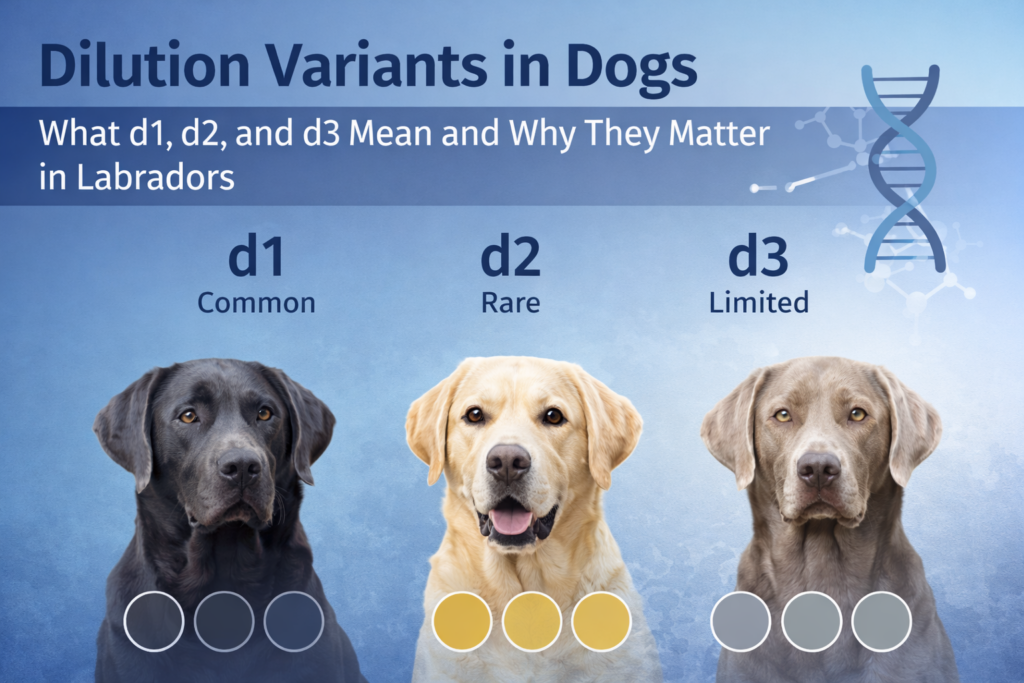
What d1 d2 and d3 Mean and Why They Matter in Labradors
Discussions about dilute Labradors often assume there is a single “dilute gene” that behaves the same way across all breeds. In reality, dilution is caused by multiple variants at the same genetic locus, each with different population histories.
If you are unfamiliar with the basic genetics and history of dilution in Labradors, read Understanding Dilution in Labradors Genetics History and the Source of the Controversy first:
https://www.thelabrador.site/understanding-dilution-in-labradors/
Understanding these variants helps clarify why dilution is accepted in some breeds, questioned in others, and frequently misunderstood in Labradors.
The dilution gene in simple terms
Dilution in dogs is caused by variants at the MLPH gene, which influences how pigment is distributed within the hair.
When dilution is present
black pigment appears charcoal or blue
brown pigment appears silver or champagne
Dilution does not remove pigment. It alters how evenly pigment is distributed within the hair, producing a lighter visual effect.
Why there is more than one dilute variant
Genetic testing has shown that dilution does not arise from a single universal mutation. Instead, there are multiple loss of function variants at the MLPH gene that affect the same biological process.
These variants are commonly referred to as
d1
d2
d3
They produce similar visible outcomes but arose independently in different dog populations.
The d1 variant
The d1 variant is by far the most widespread dilution mutation.
It is found across many Western dog breeds, including
Doberman Pinschers
Weimaraners
Chesapeake Bay Retrievers
Newfoundlands
Cane Corsos
French Bulldogs
and others
When dilution appears in Labradors, it consistently maps to the same d1 variant observed across these established breeds. This places Labradors firmly within the known genetic landscape of canine dilution rather than outside it.
There is no evidence of d2 or d3 in Labradors and no evidence of a Labrador specific dilution mutation.
The d2 variant
The d2 variant is much rarer and far more breed restricted.
It has been identified primarily in
Chow Chows
Shar Pei
Tibetan Mastiffs
This variant appears to have arisen in Asian landrace populations and did not spread widely into Western breeds before studbooks closed.
There is no credible evidence that d2 exists in Labradors.
The d3 variant
The d3 variant is the rarest of the known dilution mutations.
It has been identified in limited populations, most notably within some Chow Chow lines. Its distribution is narrow, and it is not routinely included in all commercial testing panels.
There is no evidence of d3 in Labradors.
Why Labradors only show d1
The distinction in Labradors is not genetic uniqueness but interpretation.
A widely shared dilution variant is being evaluated through the lens of a breed whose identity became closely associated with a narrow set of visual traits. As a result, the presence of a common genetic mechanism has been treated differently in Labradors than in breeds where dilution existed during early population formation.
This difference reflects how traits are interpreted within a standardized population rather than any molecular difference in the gene itself. A broader explanation of this context is covered in the foundational article linked above.
Health considerations and variant differences
All dilution variants affect pigment distribution, but coat health outcomes are not uniform.
Not all dogs carrying d1 experience coat issues.
Coat structure and selection pressure play significant roles.
Color alone does not predict overall health.
Ethical evaluation therefore requires assessing the whole dog and the whole breeding program rather than treating dilution as a proxy for quality or legitimacy.
Why understanding variants matters
Understanding dilution variants helps prevent several common errors:
Assuming all dilute dogs share the same origin story
Treating visual similarity as genetic equivalence
Confusing population history with molecular genetics
Reducing ethical assessment to color alone
For Labradors, recognizing that dilution maps exclusively to d1 allows the discussion to move away from speculation and toward responsible population management.
Summary
Dilution in dogs is caused by multiple variants at the MLPH gene. Among these, d1 is widespread across Western breeds, while d2 and d3 are rare and geographically restricted.
In Labradors, the presence of d1 aligns the breed with a broad group of established dogs and removes the need for speculative explanations. What remains is not a question of genetics, but one of how visible traits are evaluated and managed within a modern population.