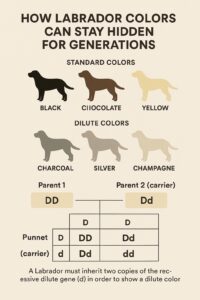

And Silver Labradors Are the Proof
There are few words thrown around more casually and more self righteously in the dog world today than ethical. It is invoked as a moral trump card, a conversation ender, and a way to exile breeders who do not conform to a narrow cultural script.
Nowhere is this more obvious than in discussions surrounding Silver Labradors and so called designer or hybrid dogs.
The irony is this. When you strip away the rhetoric, most accusations of unethical breeding collapse under even basic scrutiny.
The Myth of the Genetically Clean Dog
Let us start with a fact that no serious student of canine genetics disputes.
There is no genetically clean breed.
Every purebred population carries inherited disease. Every hybrid does too. There is no exception.
Hip dysplasia, elbow dysplasia, cancer, epilepsy, autoimmune disease, cardiac defects, orthopedic instability, eye disease, and coat related disorders exist across every breed group. Many of the most celebrated and aggressively defended breeds have institutionalized health problems protected by their own standards.
If the presence of genetic risk alone makes breeding unethical, then all breeding is unethical, including the breeds most loudly defended by their gatekeepers.
That position is rarely stated openly because it would invalidate the entire hierarchy.
Breed Standard Is Not a Moral Category
Breed standards are descriptive documents created by humans at a particular moment in time. They are not moral law.
They describe appearance. They do not guarantee health. They do not ensure longevity. They do not prevent suffering.
Yet in modern dog culture, staying within standard has been elevated to a moral virtue, while stepping outside of it is treated as ethical failure.
That is not ethics. That is rule worship.
A Labrador Retriever does not become healthier because a registry declares one shade acceptable and another forbidden. Health outcomes do not change because a color is controversial. Biology does not care about paperwork.
What Ethics Actually Requires
Ethics in breeding is not about purity. It is about responsibility.
At minimum, ethical breeding involves:
Health testing relevant to the breed or breeds involved
Intentional selection not accidental pairing
Limiting litters and respecting the dam
Transparency about risks and traits
Lifetime accountability for dogs produced
A breeder who does these things is behaving ethically regardless of whether the dog fits a historical aesthetic preference.
Conversely, a breeder who hides behind papers while ignoring known disease, overbreeding for demand, or deflecting responsibility is not behaving ethically simply because their dogs are within standard.
Ethics is about process and outcomes, not institutional approval.
The Backyard Breeder Smear
The term backyard breeder once had a meaningful definition. It referred to people who bred without testing, planning, accountability, or responsibility.
Today, it is often used to mean something far simpler.
Someone outside the approved system.
It has become a thought terminating label used to avoid engaging real questions about health, demand, and outcomes. It allows people to assign motive without evidence and dismiss breeders without argument.
Ironically, many breeders who serve the actual pet market responsibly are dismissed outright, while breeders producing dogs for prestige alone are celebrated regardless of health realities.
The Silver Labrador Panic Is a Case Study
Silver Labradors expose this contradiction perfectly.
The accusations are familiar.
They are unhealthy
They are unethical
They ruin the breed
They are bred only for money
Yet when pressed for comparative data, the conversation shifts to speculation, innuendo, and appeals to authority.
Where are the statistics showing worse outcomes than standard colors
Where are the longevity studies
Where is the evidence of increased suffering relative to other Labradors
These questions are rarely answered because the outrage is not rooted in data. It is rooted in boundary enforcement.
Silver Labradors violate an identity, not a health threshold.
The Pet Market Exists Whether Gatekeepers Like It or Not
Most Labradors are not bred for the show ring. They are bred for families.
Pretending the pet market is morally inferior does not make it disappear. It simply pushes demand into less transparent spaces.
Ethical breeders who serve the pet market responsibly are not the problem. They are the solution.
The real ethical failure is refusing to engage reality while condemning those who do.
Real Ethical Questions the Dog World Avoids
If the conversation were honest, these questions would be unavoidable.
Is preserving a written standard more important than improving health
Is preventing a dog from existing morally superior to managing risk responsibly
Is a pet home inferior to a show or work home
Who decides which humans deserve access to dogs
These questions are uncomfortable because they expose how often ethics has been replaced with status protection.
Conclusion
Ethics in dog breeding has been hijacked by tribalism.
The word is now used less to describe responsible behavior and more to enforce belonging. Those inside the circle are presumed moral. Those outside are presumed guilty.
Silver Labradors did not create this problem. They revealed it.
The future of ethical breeding will not be decided by purity tests, registry politics, or moral posturing. It will be decided by breeders willing to prioritize health, honesty, accountability, and outcomes over ideology.
Anything less is just noise.