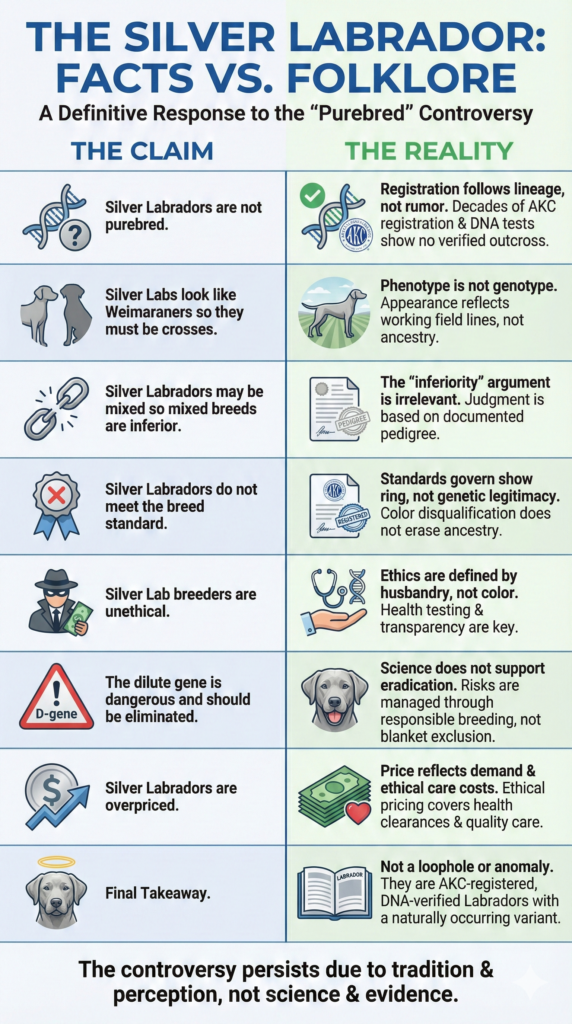


A Definitive Response to this article: https://www.thelabradorsite.com/reasons-people-dislike-silver-labs/ & to the “Purebred” Controversy
The debate surrounding Silver Labradors is often driven by tradition rather than data. To understand the Silver Lab, one must separate the administrative rules of the show ring from the biological realities of the breed.
Callout 1: The “Mixed Breed” Myth
- The Claim: Silver Labradors are the result of recent crossbreeding (mongrels).
- The Reality: Registration follows lineage, not rumor. After decades of intense scrutiny, no verified evidence of a recent outcross has ever been produced. Modern Silver Labradors have been AKC-registered across numerous generations and routinely return “100% Labrador Retriever” results on high-density DNA panels. If proof of crossbreeding existed, the AKC—an organization protective of its registries—would have revoked their status years ago.
Callout 2: The Weimaraner Comparison
- The Claim: Silver Labs look like Weimaraners, so they must be crosses.
- The Reality: Phenotype (appearance) is not genotype (ancestry). Silver Labradors emerged primarily from working “field” lines. These lines have historically prioritized athletic performance over the “blocky” aesthetic of show lines. A leaner frame or a longer ear is a hallmark of working retriever history, not proof of a secret Weimaraner ancestor.
Callout 3: The “Inferiority” Argument
- The Claim: If a dog is mixed, it is genetically inferior.
- The Reality: This argument is a logical fallacy. Since there is no empirical proof that the Silver Labrador is a mixed-breed dog, the debate over the “merit” of mixed breeds is irrelevant. A Silver Labrador is judged on its documented pedigree and its functional health, not on a hypothetical scenario.
Callout 4: The Breed Standard Paradox
- The Claim: Silver Labradors do not meet the breed standard.
- The Reality: Standards govern the show ring, not genetic legitimacy. The breed standard is an aesthetic “wish list” created by a parent club. Many purebred dogs (those with excessive white, incorrect bite, or “fluffy” coats) fail to meet show standards, yet they remain 100% purebred. A color disqualification prevents a dog from winning a ribbon; it does not erase its ancestry.
Callout 5: The Ethics of Color
- The Claim: Breeding Silver Labradors is inherently unethical.
- The Reality: Ethics are defined by husbandry, not color. Responsible breeding is characterized by rigorous health testing (hips, elbows, eyes), genetic screening, and temperament selection. Irresponsible “backyard” breeding exists in Black, Yellow, and Chocolate Labradors just as frequently. A breeder’s ethics are determined by how they care for their dogs, not the shade of the coat they produce.
Callout 6: The “Dangerous Gene” Narrative
- The Claim: The dilute gene is a health hazard that must be eliminated.
- The Reality: Science does not support gene eradication. While Color Dilution Alopecia (CDA) exists in many breeds, it is exceptionally rare in Labradors. Eliminating all dilute-carrying dogs would arbitrarily shrink the Labrador gene pool, reducing overall genetic diversity. Health risks are effectively managed through selective, responsible breeding—not by purging a portion of the population.
Callout 7: Market Value vs. Deception
- The Claim: Silver Labradors are “overpriced” scams.
- The Reality: Market price reflects demand and the cost of quality care. The expenses of ethical breeding—veterinary clearances, high-quality nutrition, and genetic testing—remain the same regardless of coat color. Pricing becomes an ethical issue only if a breeder uses deceptive terms like “rare” to justify a lack of health testing. A fair price for a healthy, tested dog is a reflection of the breeder’s investment.
Final Takeaway
Silver Labradors are not a loophole or a modern anomaly. They are AKC-registered, DNA-verified Labradors expressing a naturally occurring genetic variant. The controversy persists because of a clash between 100-year-old traditions and modern genetic reality. In the eyes of science and documentation, a Silver Lab is exactly what its paperwork says it is: A Labrador Retriever.