
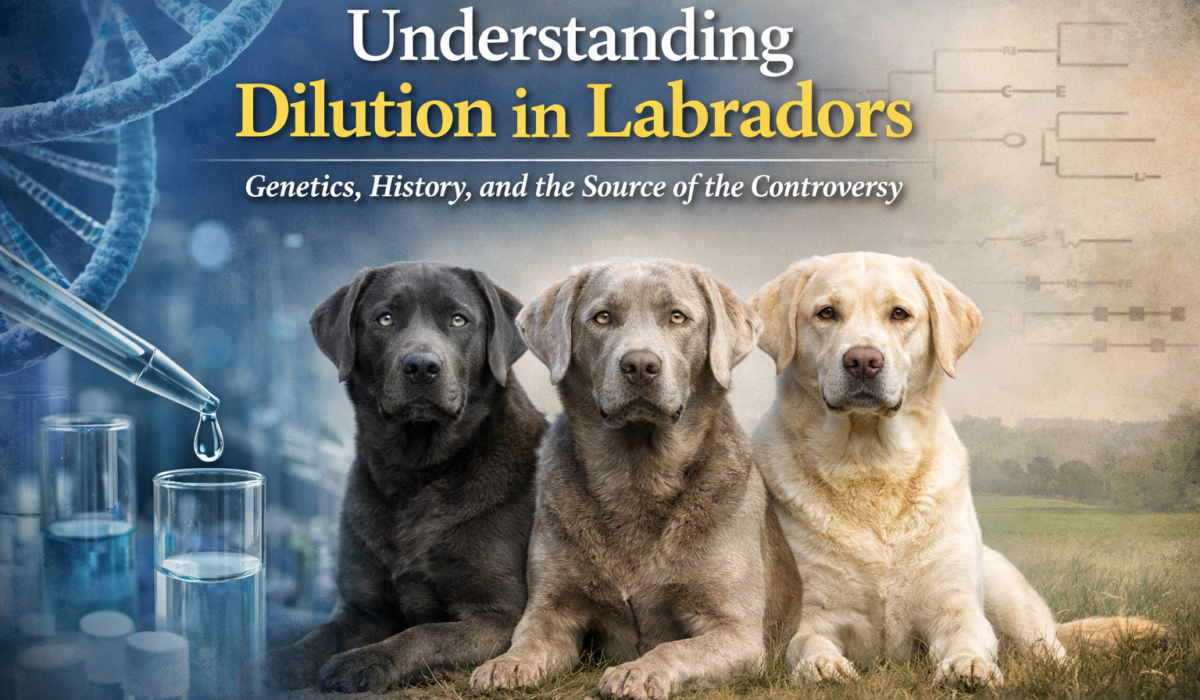
Understanding Dilution in Labradors Genetics History and the Source of the Controversy
Dilute coat colors in Labrador Retrievers remain one of the most debated topics in the breed. Silver charcoal and champagne Labradors often provoke strong reactions that blend genetics tradition ethics and emotion into a single conversation.
This page exists to clarify that conversation.
The purpose here is not to promote or oppose any particular color. It is to explain what dilution is at the genetic level why it is controversial in Labradors and why that controversy continues even when the underlying science is well understood.
Clear thinking begins by separating genetics from narrative.
What dilution is at the genetic level
Coat color dilution in dogs is caused by variants at the MLPH gene, which affects how pigment granules are transported within the hair shaft. When that process is altered the pigment is distributed differently and appears lighter in the coat.
In practical terms
black appears as charcoal or blue
brown appears as silver or champagne
In Labrador Retrievers every genetically tested dilute dog to date carries the same common MLPH variant often referred to as d1.
This is not unique to Labradors.
The same molecular variant appears across many Western dog breeds including Doberman Pinschers Weimaraners Cane Corsos Chesapeake Bay Retrievers Newfoundlands and others.
There is no evidence of
a Labrador specific dilution mutation
multiple dilution variants segregating in Labradors
or a distinct dilution mechanism within the breed
At the level of molecular genetics the explanation is straightforward.
Why genetics alone does not explain the controversy
If the same dilution variant exists across many breeds a natural question follows.
Why is dilution broadly accepted in some breeds but disputed in Labradors.
The answer is not found in DNA.
It is found in history timing and breed identity.
Timing and breed formation matter
Many breeds that carry the d1 variant developed before modern kennel clubs enforced narrow and rigid color definitions. Their early populations were smaller more fluid and less tightly standardized.
In breeds such as Chesapeake Bay Retrievers and Newfoundlands dilution existed during or near the formative period of the breed. It became part of the background genetic landscape even when later selected against or discouraged.
Labradors developed differently.
By the time the Labrador Retriever became globally standardized the breed identity had already become strongly associated with three colors black yellow and chocolate. Studbooks were effectively closed and population size expanded rapidly.
Dilution appears in Labradors after that identity was culturally and institutionally established.
That difference in timing explains much of the reaction.
Why certain narratives persist
When controversy arises people often gravitate toward simple explanations rather than complex ones.
Pointing to an external source for dilution provides
a clear boundary violation
an easy mental image
and a sense of breed purity being disrupted
Such narratives persist not because they are genetically required but because they are emotionally effective.
In reality the widespread presence of the d1 variant across Western breeds shows that the mutation itself is neither exotic nor rare. What distinguishes Labradors is not the gene but when it became visible relative to breed standardization.
Health concerns and ethical breeding
Concerns about coat related conditions such as Color Dilution Alopecia are real in some breeds and some lines. They deserve thoughtful attention.
They also require nuance.
Not all dogs carrying the d1 variant develop coat pathology. In fact evidence points to that it is relatively low in the Labrador Retriever. Risk varies depending on coat structure selection pressure and overall genetic management. Color alone does not predict health or quality.
Ethical breeding evaluates the whole dog and the whole population rather than treating any single trait as a moral shortcut.
Once a trait exists in a large closed population the ethical responsibility shifts from denial to responsible management.
This principle applies to hips elbows eyes temperament structure and coat alike.
What is often missed in public discussion
Much of the debate assumes that acknowledging dilution in Labradors requires rewriting history or abandoning breed standards.
It does not.
It requires recognizing that
breed standards are cultural frameworks that can and do change
genetics operates independently of registry politics
and modern populations cannot be managed as if time can be reversed
Clarity comes from distinguishing molecular genetics from symbolism and tradition.
A clearer way forward
The future of the Labrador Retriever will not be shaped by internet arguments about origin stories.
It will be shaped by
transparent genetic testing
responsible selection practices
honest population level thinking
and a commitment to clarity over controversy
Understanding dilution accurately allows breeders owners and judges to engage the topic without fear distortion or hostility.
That clarity is the purpose of this page.